
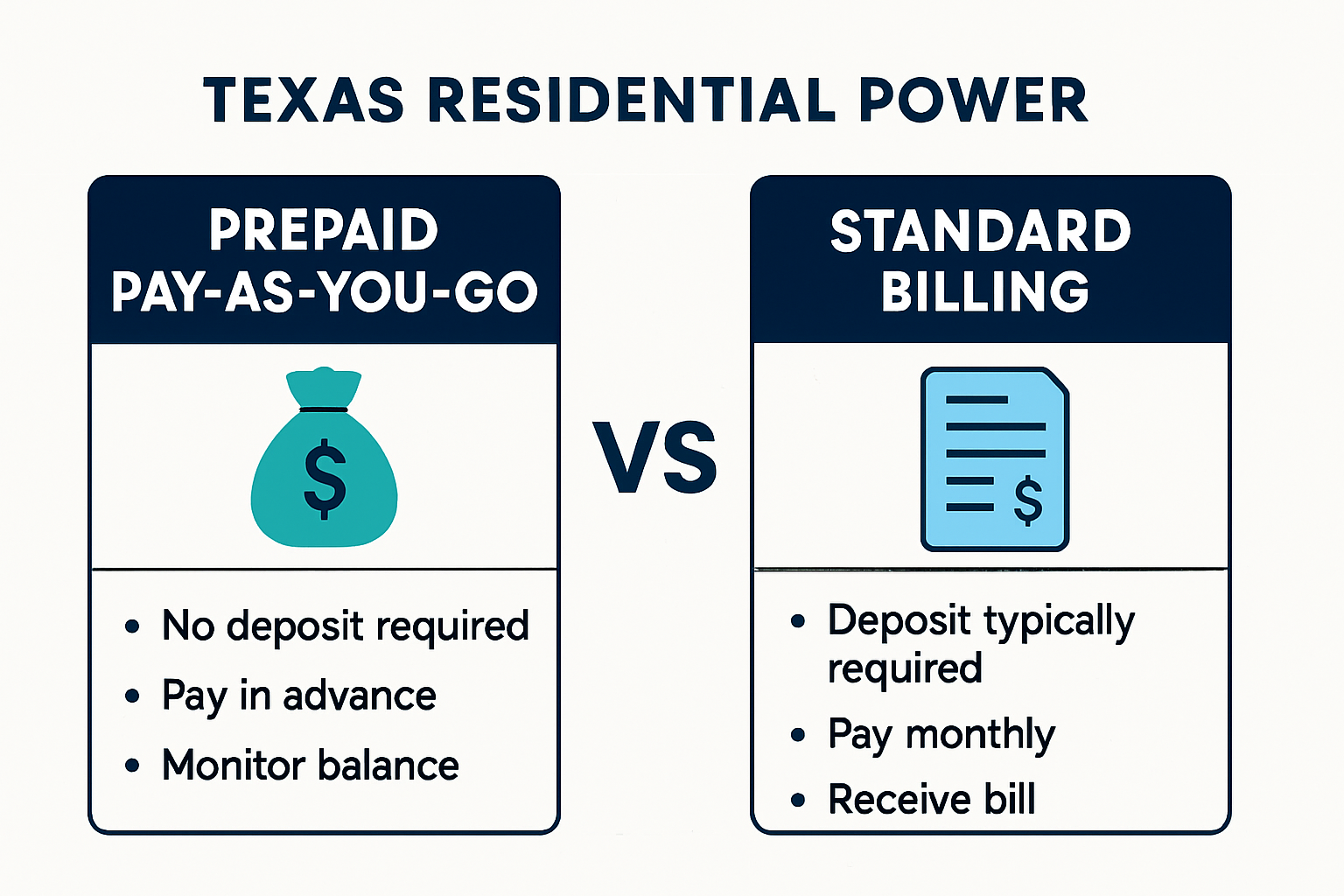
Prepaid vs Standard Billing: How Texas Home Electricity Gets Paid For
Why Texas Feels Different on Your Bank Statement
If you have only ever lived where one utility sends one familiar monthly statement, Texas can feel like it runs on a different operating system. In much of the state, the organization that keeps the lights physically flowing is not the same brand name that sells you a rate plan, and the market structure that sits underneath your bill is unusually visible once you start reading the fine print.
This piece is for the curious household that already knows what a kilowatt-hour is, but still wonders why a neighbor can talk about “loading the account” like a phone plan while someone else brags about autopay on a classic postpaid contract. The goal is not to crown a winner. It is to separate what is marketing flavor from what is regulatory scaffolding, so you can pick the payment cadence that matches how you actually live.
The Electric Reliability Council of Texas explains that it serves as the independent system operator for the region, scheduling power across a grid tied to more than 55,000 miles of transmission lines and more than 1,460 generation units, while also handling financial settlement for the competitive wholesale bulk-power market and administering retail switching for about eight million premises in competitive choice areas (¹). ERCOT also notes that it manages power flows for more than 27 million Texas customers, representing about 90 percent of the state’s electric load (¹). That scale matters because it frames what “normal” looks like here: a large, dynamic system where retail offers, wholesale conditions, and local delivery charges can all show up in different line items depending on your plan.
ERCOT describes itself as a membership-based nonprofit corporation governed by a board and overseen by the Public Utility Commission of Texas and the Texas Legislature, with members spanning consumers, cooperatives, generators, marketers, retail electric providers, investor-owned utilities, transmission and distribution providers, and municipally owned utilities (¹). You do not need to memorize that roster to pay a bill, but it helps explain why public conversations about Texas power markets can sound like a town hall and a trading floor at the same time: many stakeholders share the same physical network even when your household only interacts with a slick retail brand.
Same Wires, Two Checkbooks: TDUs, REPs, and What You Are Buying
Texas Electric Choice’s consumer FAQ walks through the basic split people still mix up after years in the market: in competitive areas you pick a retail electric provider, or REP, while the same local wires company—often called a transmission and distribution utility, or TDU—continues to deliver power, read the meter, respond to outages, and maintain poles and wires (²). Reliability of delivery does not change based on which REP you pick; the TDU remains regulated for that delivery function (²).
That separation is the key to comparing prepaid and standard billing fairly. You are not choosing between two different physical grids. You are choosing between two different ways a REP wraps the same underlying ingredients—energy, market charges however your contract assigns them, and pass-through delivery-related charges—into a relationship with your household budget.
It also changes who you call first when something looks wrong. Texas Electric Choice says billing questions should go to your electric company, and that if you have an outage you should immediately call your local wires company—the TDU—using the toll-free number on your bill (²). That little routing rule saves a surprising amount of weekend frustration once it becomes habit.
Standard Billing: The “Use First, Invoice Later” Rhythm
Most people picture Texas competitive retail as a monthly rhythm: you use kilowatt-hours, the meter accumulates them, and then a bill arrives summarizing what you owe. Texas Electric Choice notes that the Public Utility Commission of Texas has rules requiring companies to provide an easy-to-read bill, and that unless your plan is prepaid, your bill will be mailed monthly, with electronic delivery possible if you and the company agree (²). How itemized that bill looks can vary by company; the FAQ is blunt that design choices are up to each provider (²).
Under that model, the household’s mental model is basically cash flow next month for usage that already happened. That can be comfortable when income is steady and surprises are rare. It can sting when weather spikes usage, when a minimum-usage style fee applies, or when a promotional rate rolls off—because the invoice is where those realities land, not always in the marketing headline.
There is also a quieter rhythm around renewals that hits standard postpaid customers hardest when life gets busy. Texas Electric Choice explains that if you have service on a contract with three or more months remaining, your company must notify you in writing about an approaching expiration at least 30 days or one billing cycle—and no more than 60 days or two billing cycles—before the contract ends, and it notes you should renew or pick a new provider before the end date to avoid being automatically switched to a month-to-month variable rate plan (²). Prepaid shoppers are not magically immune to price changes either, but that automatic post-contract drift is one of the places where “standard billing” stories on social media tend to originate.
Prepaid and Pay-as-You-Go: Money Before Megawatt-Hours
Prepaid service flips the timing. Instead of waiting for a monthly statement to reconcile what you already consumed, you fund an account and draw it down as you go—closer to a debit card than a traditional postpaid utility bill. Texas Electric Choice’s shopping user guide explicitly includes a filter to view prepaid plans, describing it as a step where you can select whether you want to see prepaid offers (³).
The prepaid label can cover more than one implementation in the wild—some setups lean hard on daily text alerts, others emphasize autopay top-ups, and contract mechanics still matter—but the consumer-facing distinction Texas Electric Choice highlights in its billing FAQ is simple: prepaid is the exception to the default expectation that a non-prepaid plan produces a mailed monthly bill (²). Practically, that often translates into a household budgeting style that favors smaller, more frequent cash movements instead of one large monthly settlement.
People reach for prepaid for different human reasons: roommates splitting costs without a joint checking account habit, households rebuilding after a rough credit stretch, families that would rather get a ping than a surprise envelope, or anyone who simply likes the feeling of paying forward. None of that changes the underlying physics, but it does change how tightly your bank account and your thermostat talk to each other week to week.
Price Tags, Headline Rates, and the Stuff That Actually Moves the Needle
It is easy to treat prepaid versus postpaid as a personality quiz, but the money still obeys arithmetic. A low advertised rate can quietly lose to fees, pass-throughs, and usage patterns that do not match the plan’s shape. Texas Electric Choice nudges shoppers toward the Plans page and ZIP-code entry as a practical way to see which companies serve an area, and it repeats that standardized labels exist so you are not comparing apples to oranges (²). That is the part of the workflow where a prepaid filter is less a lifestyle statement and more a search constraint: show me offers built the way I want to pay (³).
Think in bundles, not vibes. A household that is rarely home might care more about minimum-usage pitfalls than about whether the wallet is prepaid. A household with volatile weekly income might care more about avoiding a single large monthly settlement than about chasing the absolute lowest theoretical cents-per-kWh on a spreadsheet. A household that travels often might care more about contract expiration notices and variable-rate drift than about the payment rail itself. None of those tradeoffs show up in a billboard headline, which is exactly why regulators push standardized disclosures in the first place (²).
When Payments and Usage Do Not Line Up
Standard postpaid accounts eventually collide with nonpayment rules like any other household service. Texas Electric Choice’s FAQ states plainly that electricity can be disconnected for nonpayment, and that you should receive a termination notice giving you ten days to pay the bill or make payment arrangements (²). That is a formal rhythm: a notice window, then consequences if the gap persists.
Prepaid accounts have their own version of “out of balance,” usually much faster feedback when the funded balance approaches zero. The right mental model is not “prepaid can never disconnect you,” but “prepaid changes when and how you discover you are off pace.” Some households prefer that immediate signal; others find it stressful if income arrives in lumpy chunks that do not align with daily draws.
The Fine Print That Matters for Both Models
Deregulation, Choice, and Who It Reaches
Texas Electric Choice summarizes the legislative history this way: in 1999 the Texas Legislature passed a deregulation law that made it possible for consumers in most parts of Texas to choose their own electric company, with the stated goal of encouraging competition and lower prices, while noting that some municipally served areas and cooperatives were not required to deregulate (²). It also notes that whether you have choice depends on where you live (²). That geographic caveat matters: articles like this one often speak “Texas” in shorthand, but your address still dictates whether you are shopping REPs at all.
Minimum Usage and Bill Surprises
Texas Electric Choice warns that many plans require a minimum amount of electricity each month, and if you use less than that minimum you can be charged a fee that may or may not be listed separately on your monthly bill—so checking the Electricity Facts Label matters (²). That is a prepaid-or-not issue: skinny usage months can trigger fees in either billing style if the plan is built that way.
Switching Mechanics and Market Continuity
If you are weighing prepaid versus standard as part of a switch, the FAQ’s process details are useful guardrails. It says you can choose a new plan or company at any time but warns there may be penalties if you break an existing contract, that after you sign a new contract you will receive a mailer from ERCOT confirming your switch, that you then have three business days to change your mind, and that the switch happens automatically within seven business days with no lapse in service (²). It also notes there is no switching fee unless you request a special meter reading outside your regular schedule (²).
Second thoughts happen. Texas Electric Choice says you may contact the company to cancel a switch within three business days from the time you receive your Terms of Service agreement—whether that agreement arrived by mail or you enrolled online—and it notes the ERCOT confirmation mailer should include a way to cancel the new contract (²). That is a useful backstop when someone signs up at the kitchen table after a long shift and wakes up unsure the next morning.
For rarer failure modes—like a provider exiting—the FAQ explains you should not be left without electricity, describing advance notice in many cases and automatic assignment to a Provider of Last Resort if a company stops serving suddenly, with additional detail pointing readers to PUC fact sheets (²). Those are market-structure backstops that sit underneath whichever billing flavor you pick.
Slamming, Cramming, and Disputes
Texas Electric Choice also summarizes illegal slamming (switching you without permission) and cramming (adding charges without permission), and directs billing disputes first to the company, then to the PUC consumer hotline if needed (²). Those protections apply regardless of whether you are funding an account ahead of time or paying after the fact.
Customer Rights and Language Access
The FAQ’s “Your Rights” section is worth skimming even if you are not the type to read consumer guides for fun. It states that customers have the right to choose a provider—including staying with an original company—and that the PUC is responsible for protecting those rights (²). It also lists non-discrimination rules, slamming and cramming prohibitions, dispute resolution paths, privacy protections, and a bundle of required disclosures such as an Electricity Facts Label, Terms of Service, a “Your Rights as a Customer” disclosure, and notice of contract expiration for longer agreements (²). On language access, it notes companies must make customer information available in Spanish and must make marketing materials available in the languages of their customers (²). Those are baseline market hygiene rules that sit underneath both billing styles.
Neutral Information and Comparison Shopping
Texas Electric Choice is explicit that it does not recommend any particular provider or plan because it is intended as a neutral information source, while still pointing people to tools like the Plans page to see which companies serve an area (²). That neutrality matters when you are comparing prepaid against postpaid offers side by side: the portal is trying to be a fence, not a coach, even as it nudges you toward standardized documents that make comparisons less hand-wavy (²).
A Straight-Shooter Way to Shop Without Turning It Into a Hobby
If the goal is simply to pick a lane—prepaid discipline versus monthly reconciliation—the boring checklist is still the best one. Texas Electric Choice emphasizes standardized plan documents: an Electricity Facts Label for rates, fees, and contract terms, plus a Terms of Service agreement as the contract (²). It also notes that companies are required to provide an Electricity Facts Label for each plan and that the label contains standardized information meant to make offers comparable (²). When you are toggling prepaid filters in the shopping UI, that is the document where you translate marketing adjectives into numbers you can live with (³).
If you are switching providers, Texas Electric Choice states that you will receive your first electric bill from your new electric company on the following billing cycle (²). That is a small detail, but it helps households avoid the “did something break?” panic window when mailboxes go quiet for a couple of weeks.
For apples-to-apples comparisons, independent shopping portals exist specifically to make offers searchable by ZIP and plan type; Watt Karma positions itself as one such comparison path focused on surfacing plan options and rate transparency for people who do not want to chase PDFs site by site (⁴).
Three gut-check questions usually decide the billing style faster than a spreadsheet: Do you manage money better in small weekly slices or one monthly reconciliation? Do you want the REP relationship to behave like a utility invoice or like a funded wallet? And are you disciplined about reading contract end dates, or do you need guardrails that reduce “autopilot drift” after promos end? There is no moral trophy for picking either answer—only a bill you can pay on time.
Where that leaves a thoughtful reader is less “which label wins on Twitter” and more “which payment cadence matches your household’s cash flow and attention budget.” Standard billing rewards people who can tolerate a monthly reconciliation shock absorber. Prepaid rewards people who want tighter coupling between today’s balance and today’s behavior. The physics—TDU delivery, ERCOT’s role in the broader competitive landscape, and the meter at your house—does not care which one you pick; your calendar and your risk tolerance usually do.
In competitive areas of Texas, the market gives you both doors. The job is to walk through the one whose rules you will actually follow when July heat or a January cold snap shows up, because the grid will keep score either way.