
Residential Battery Backup: When “Whole Home” Is a Math Problem, Not a Mood
Outages expose circuits, not slogans
When utility power disappears, a house rarely goes dark as a single monolith. Breakers, wire sizes, and habits mean some parts of the property stay urgent while others become optional luxuries you can defer until the grid returns. That uneven reality is why backup power conversations belong in the electrical panel first and the marketing brochure second, long before anyone starts rounding kilowatt-hours to the nearest sticker price.
Trade coverage on home energy storage often frames the category in storm-and-heat terms, arguing that distributed solar-plus-storage can aggregate into a “virtual power plant” that helps keep essential service running when bulk power is strained (¹). You do not have to sign up for a utility program to borrow the underlying lesson: your backup design is still a circuit-level problem—breaker limits, start-up currents, and conductor ampacity do not care whether your inverter is philosophically “whole home” or “partial home.”
Government surveys of how U.S. homes use electricity make the mismatch vivid. In 2020, air conditioning, space heating, and water heating each represented roughly 12–19% of annual household site electricity consumption, while end uses such as lighting and refrigeration sit in a different bucket: nearly universal, but not always dominant on a percentage basis in the same way as seasonal thermal loads (²). Those shares move with weather and housing stock, which is exactly why a backup plan that ignores load diversity can oversize hardware—or fail the first hot evening.
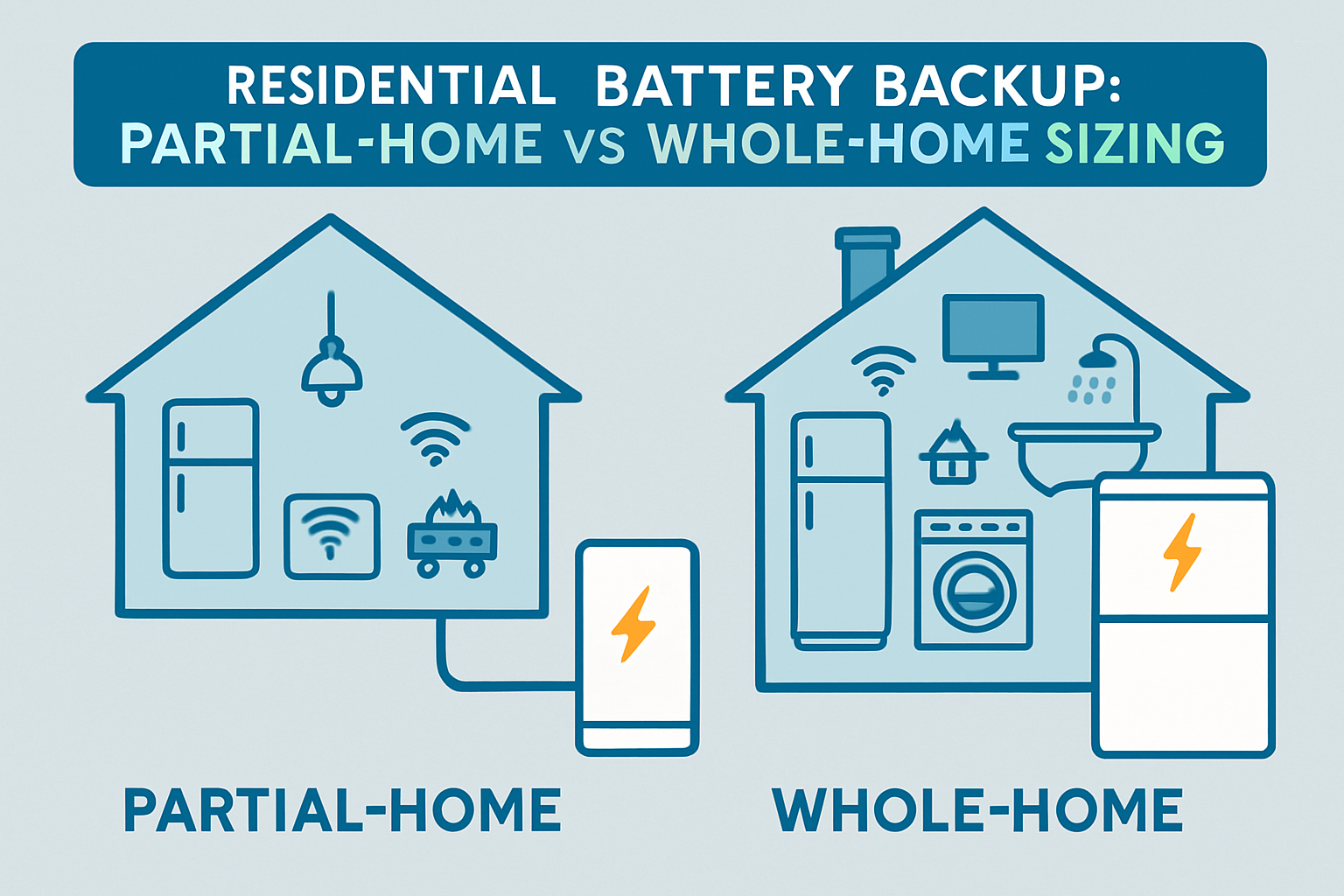
At the same time, the average U.S. household consumes on the order of 10,500 kilowatt-hours per year, with wide variation by region and housing type. EIA summarizes the spread bluntly: apartments in the Northeast consume the least electricity annually, while single-family detached homes in the South consume the most, partly because southern homes are more likely to rely on electric heating and use more air conditioning (²). A “whole-home” backup concept implicitly asks a battery and inverter stack to stand in for that year-round profile for some period of time. A partial-home (often called critical-load) design instead narrows the electrical scope—typically via a subpanel, transfer equipment, and disciplined load management—so the inverter and storage can be smaller, less expensive, and easier to integrate with existing service equipment.
What “critical loads” actually means in practice
“Critical” is not a mystical label from a manufacturer; it is an owner-defined priority list translated into branch circuits. In practice, designers start with life-safety and communications: smoke detection pathways where applicable, select lighting, modem/router gear, a handful of receptacles, and often a kitchen circuit that keeps a refrigerator viable. Medical-support equipment, sump pumps, and garage door operators frequently appear on the short list because their failure modes are expensive or dangerous, not merely inconvenient.
EIA’s residential overview underscores why refrigeration is almost always in the conversation: nearly all homes—about 99%—have a refrigerator, and many households run more than one cold box (²). The same source adds texture that matters for “silent” baseload during an outage: in 2020, 34% of U.S. homes had two or more refrigerators, with second units and separate freezers especially common in certain regions (²). If your mental model of backup assumes one modest compressor, walk the kitchen and the garage again.
EIA also places lighting and refrigeration together as end uses that show up in nearly every home, describing them as the “next two largest electricity end uses” after the big thermal categories—while reminding readers that the rank order of shares can change year to year with weather (²). Translation for backup planning: lighting is often more about fixture count and behavior than about a single heroic load, whereas refrigeration is a steady, inflexible obligation once you commit to keeping food safe.
If you are trying to calibrate what “always on” feels like in dollars rather than watts, the same EIA page offers a sobering household snapshot from 2020: the most-used refrigerator cost about $87 on average to operate for the year, while a second refrigerator averaged about $66, with separate freezers about $74 (²). Those are not huge line items compared with space conditioning, but they are the loads you will notice first in backup mode because they do not politely “take a break” when the inverter is near its limit.
Comfort loads—especially space cooling—are a different design animal. EIA notes that about 89% of U.S. homes used air conditioning in 2020, compared with 57% in 1980, and that the share with central air rose from 27% to 67% over the same interval (²). Running central air from batteries is technically possible in some all-electric homes, but it is often the line item that explodes both continuous power (inverter capacity) and energy (kilowatt-hours) requirements. Partial-home strategies therefore frequently treat cooling as staged: first guarantee fans and a single mini-split head, defer whole-house temperature control, or plan for a generator shoulder during extreme heat.
Water heating and space heating also deserve explicit honesty. EIA’s end-use shares place water heating at about 12% and space heating at about 12% of residential site electricity in 2020, with air conditioning at about 19% in that same framing (²). If your backup scheme silently assumes “everything except the EV charger,” you may still be assuming thousands of watts of resistive or heat-pump load that only shows up in winter or morning shower peaks.
Whole-home backup: the full substitution fantasy
Whole-home backup, in the colloquial homeowner sense, aims to keep the main service bus energized so that life inside the meter looks as close to normal as possible. Electrically, that implies an inverter or hybrid system sized for simultaneous demands: the well pump while the oven preheats while someone dries towels while the heat pump calls for aux. Even if those overlaps are rare, equipment must be rated for credible peaks, not for your “typical Tuesday.”
Department of Energy materials describing how solar technologies work remind readers that sunlight-derived electricity “can be used to generate electricity or be stored in batteries or thermal storage,” which is a useful mental model for why vendors pair PV with electrochemical storage in the first place (³). The same office’s overview page repeats the coupling of generation with storage options and illustrates residential rooftop applications in passing (⁴). None of that federal copy tells you how many kilowatts your air handler needs; it simply anchors the physics: storage is there to time-shift energy, not to repeal Ohm’s law.
At grid scale, industry associations describe battery storage as dispatchable backup that charges when energy is abundant and discharges when demand rises, improving efficiency and stability for the wider system (⁵). Residential designers borrow the vocabulary—“dispatch,” “arbitrage,” “peak shave”—but the homeowner problem is narrower: decide which loads are worth paying to keep online through the night, and which loads can wait for sunrise or utility restoration.
Partial-home backup: engineering for priorities, not pride
Partial-home designs usually introduce a critical-load panel fed through a transfer mechanism that isolates the home from the grid for safety. The battery inverter energizes that panel only, while the remainder of the house sits dark until utility power returns (unless additional switching schemes are added). Electricians and authorities having jurisdiction care deeply about those details; a brochure phrase is not a substitute for a plan set that matches your service layout.
Where partial-home shines is in capital discipline. Smaller inverters cost less, wire and overcurrent protection requirements shrink, and you reduce the risk of needing a main-panel upgrade solely to accommodate a very large backup bus. You also shrink exposure to hidden diversity factors: two people rarely run every large load at once, but prudent engineering still requires credible simultaneous peaks on whatever bus you back up.
The trade is behavioral. A partial-home system rewards a household that knows which breakers matter. If guests reset the wrong breaker or someone plugs a space heater into a backed-up circuit “just for a minute,” you can trip the inverter on overload exactly when you least want a puzzle.
Sizing: separate “how big a firehose” from “how big a water tank”
Two different numbers drive cost: power (kilowatts, the instantaneous delivery limit of the inverter) and energy (kilowatt-hours, how long you can sustain a given bundle of loads). Shoppers often anchor on kilowatt-hours because marketing materials emphasize battery capacity, but whole-home dreams frequently die on kilowatts first: a stack that can store a large number of kilowatt-hours is still unhelpful if it cannot start a compressor or well pump without voltage collapse.
Seasonality matters. A backup profile tuned for winter ice storms (furnace controls, a few LED circuits, fridge, comms) is not the same profile tuned for a summer heat dome. EIA’s emphasis on cooling growth and regional variation is a statistical warning label: your worst-case overlap day is not your annual average day (²).
Duration targets are a value choice, not a moral score. Some households want only a bridge across brief interruptions; others want overnight silence for refrigeration and networking; still others are planning multi-day events where any pure-battery approach collides with thermodynamics unless loads are aggressively staged or paired with another energy source. The common thread is arithmetic: average daily energy from a normal year is a poor proxy for worst-case hours during a blackout, especially if cooling or water heating is in the backed-up bundle (²).
Policy and procurement: the IRS sets a floor, not a ceiling
Federal tax law can influence equipment selection even when it does not replace a load study. The IRS states that battery storage technology may qualify under the Residential Clean Energy Credit, with a note that eligibility for batteries begins in 2023, and that qualifying battery storage technology must have a capacity of at least 3 kilowatt hours (⁶). That threshold is useful context when comparing modular systems: it is a compliance minimum for the credit, not a statement that 3 kWh carries a four-ton heat pump through August.
Because credits and utility programs change with statute and tariff filings, treat incentives as a checklist item after the electrical target is defined. The engineering question remains: what must stay energized, for how long, at what simultaneous power?
How to choose without drowning in acronyms
Start with an hour-by-hour thought experiment, not a catalog. Walk the house with someone who can read nameplates and breaker labels. For each candidate circuit, ask: peak watts, typical run hours during an outage, whether overlap with other candidates is realistic, and whether shedding the load creates safety or property-risk issues.
If the honest answers point to large thermal loads, decide up front whether you are buying inverter headroom and cell capacity for them, or whether you are buying discipline—smaller backed-up bus, staged cooling, maybe a generator for the rare worst case. There is no universal winner; there is only a bill of materials that matches how your family actually behaves when the grid is unreliable.
Finally, remember what public statistics are for here: they explain why two houses with identical square footage can justify different backup architectures. National averages on space conditioning, water heating, and cooling penetration are not a substitute for a site-specific load calculation, but they are a bracing reminder that “whole home” is often a polite synonym for “whole appetite” (²).
Takeaways for an educated shopper
- Write the outage script first. Safety, refrigeration, communications, and water control usually beat entertainment circuits.
- Treat central air as a fork in the road, not a footnote. EIA’s multi-decade cooling adoption trend explains why many retrofit backups stay partial-home by necessity (²).
- Decouple kW from kWh when comparing quotes. Energy without adequate inverter power cannot deliver comfort; power without energy dies at bedtime.
- Count the cold boxes. Second refrigerators and freezers are common; EIA’s RECS-style summary is a useful nudge to inventory what must stay online (²).
- Use incentives as a refinement, not a compass. The IRS’s minimum capacity rule for credited battery storage is explicit and easy to verify against proposals (⁶).
- Borrow grid-scale intuition sparingly. Storage that stabilizes the bulk power system solves a different optimization problem than your kitchen subpanel—but the same first principles about charging when supply is rich and discharging when it is scarce still apply at house scale (⁵).
If you remember nothing else, remember this: partial-home versus whole-home is less about moral seriousness and more about which loads you are willing to fund through a finite inverter and a finite stack of cells. Government data on where kilowatt-hours go in normal years is the quickest antidote to magical thinking about what “backup” can buy without a fuel truck, a larger service, or a colder thermostat setting when the sky goes dark (²).