
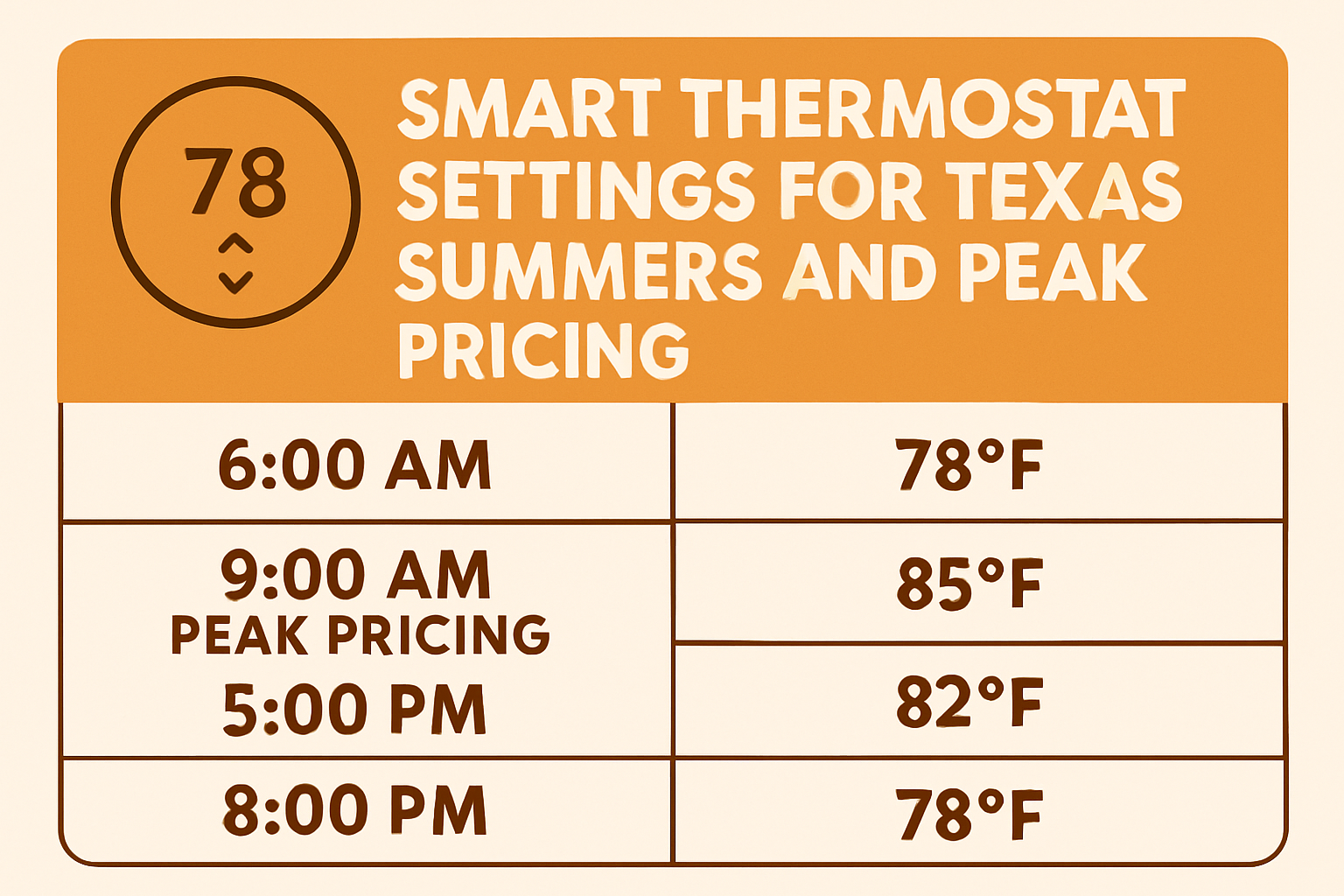
Smart Thermostat Settings for Texas Summers and Peak Pricing
When the sidewalk is sizzling, your house is fighting physics
Texas summers are not subtle: long afternoons of sun, humidity along the Gulf and eastern reaches, and city neighborhoods where pavement and rooftops bank thermal energy. The U.S. Environmental Protection Agency explains that built surfaces absorb and re‑emit more sun than forests or water, producing urban heat islands where daytime air can run about 1–7°F warmer than nearby outlying areas and nights stay roughly 2–5°F higher, with the largest contrasts tending to show up in humid, densely built regions (¹). The same overview notes that vehicles, air conditioners, buildings, and industrial facilities all dump waste heat into the urban canopy, reinforcing the effect on days when the breeze is calm and the sky is clear (¹).
NOAA’s Climate.gov overview of the global temperature record states that Earth’s average surface temperature has risen by an average of about 0.11°F per decade since 1850, or about 2°F in total, and that the pace since 1982 has been more than three times as fast. The page also flags that the ten warmest years in the historical record occurred in the past decade (2015–2024) (²). None of that replaces your local seven‑day forecast, yet it is a useful reminder that “hot August” is not just vibes; it is a trend line overlaid on already punishing seasonal peaks.
Cooling is a budget item, especially in southern homes
Before tuning schedules, it helps to know what you are actually moving on the bill. The U.S. Energy Information Administration’s Residential Energy Consumption Survey, summarized in an agency FAQ, estimated that in 2020 electricity used for air conditioning represented about 19% of U.S. residential electricity consumption—on the order of 254 billion kilowatthours nationwide (³). EIA’s broader “Electricity use in homes” overview adds regional texture: detached single‑family homes in the South use the most electricity on average, southern homes are more likely to rely on electric space heat, and southern homes run more cooling (⁴). In the same 2020 accounting, air conditioning, space heating, and water heating each represented about 12–19% shares of residential site electricity, with air conditioning at the top of that trio at about 19%. Central air is now the norm rather than the exception—EIA reports about 89% of U.S. homes used air conditioning in 2020, with central systems in about 67% of homes, up steeply compared with decades prior (⁴).
Translation for a Houston, Dallas, or San Antonio household: the thermostat is not a lifestyle gadget; it is the throttle on one of your largest discretionary loads.
What the Department of Energy wants you to do with setbacks
The Department of Energy’s Energy Saver guidance on programmable thermostats boils the strategy down to time and delta. Keeping the indoor temperature closer to outdoor conditions reduces total cooling energy because heat sneaks in more slowly when the gap is smaller (⁵). The same page states you can save roughly as much as 10% a year on combined heating and cooling by turning the thermostat back about 7–10°F for roughly eight hours a day from its normal setting, with milder climates seeing larger percentage savings than severe ones (⁵).
For summer specifically, Energy Saver recommends letting the house run warmer while you are away, then choosing the highest setpoint that still keeps you comfortable when you are home—explicitly flagging humidity control when needed—because programmable models can return to occupied temperatures before you arrive so you do not pay for deep overcooling during empty hours (⁵). The guidance also debunks a classic myth: slamming the thermostat colder than normal when you walk in does not cool the house faster; it risks overshoot and wasted kWh (⁵). In plain language the page notes that raising the summer indoor setpoint slows the flow of heat into the house, so longer stretches at that higher setting save more than brief dips (⁵).
Translating policy into a weekly rhythm
Energy Saver’s programming advice is deliberately mundane because mundanity is what makes it work: think about when you sleep and wake, stagger winter setbacks slightly ahead of bedtime if you like a cooler bedroom, and coordinate everyone’s schedule (⁵). It also states plainly that if the house sits empty four hours or more, adjusting temperature during that window makes sense (⁵). Most hardware is either digital—with rich schedules, overrides, and daylight‑saving helpers—or electromechanical, which tends to be easier for hands‑on users who dislike nested menus (⁵).
For Gulf Coast and eastern Texas homes, combine that schedule discipline with humidity awareness; Energy Saver explicitly tells you to ensure humidity control, when needed, alongside a higher summer comfort setpoint (⁵).
Peak pricing is not a conspiracy; it is how markets clear megawatts
Utility Dive’s coverage of wholesale market design, quoting trade‑group commentary, reminds readers that competitive regions rely on day‑ahead and real‑time energy markets where generators bid to meet load, and that the bulk of electricity costs trace to those energy markets rather than any single high headline figure such as a capacity auction print (⁶). The same article notes that, since competitive markets were introduced in the 1990s, the portion of the utility bill that has climbed is transmission and distribution—the segment utilities directly control—even as other market metrics moved (⁶).
On the retail revenue line, EIA’s Electricity Monthly Update for end‑use data (February 2026 tabulation) reported that total average revenues per kilowatthour rose 9.0% year over year to 14.36 cents per kWh, with the residential sector up 7.4% (⁷). The same write‑up observed forty‑three states and the District of Columbia posting higher revenue per kWh than the prior February, with the largest percentage jumps called out in Virginia, Ohio, and Pennsylvania (⁷). That kind of environment makes thermostat discipline less about virtue and more about arithmetic: every avoided kWh is more valuable when the revenue‑per‑kWh line is rising.
EPA’s heat‑island discussion ties the physical risk to infrastructure: increased air‑conditioning demand from heat islands, with literature summarized there suggesting electricity demand for air conditioning can rise roughly 1–9% for each 2°F increase in temperature in countries where air conditioning is ubiquitous, such as the United States, and noting that peak demand often stacks on exceptionally hot afternoons when offices and homes simultaneously run cooling, lighting, and plug loads (¹). Smart setbacks attack exactly that coincidence of high load and high stress.
Hardware, placement, and edge cases that trip people up
Energy Saver devotes space to thermostat location: interior walls, away from sun, drafts, doorways, skylights, and windows, with furniture kept from blocking natural air movement so the sensor sees representative air—not a sunbeam or a supply‑register blast (⁵). Poor placement makes even the best schedule lie to itself.
Heat pumps deserve a separate footnote in any Texas discussion because many newer builds use them for efficient electric heat in winter and cooling in summer. Energy Saver warns that generic programmable setbacks in heating mode can be counterproductive for conventional heat pump controls because aggressive setbacks may trigger expensive auxiliary resistance heat; cooling mode behaves more like standard air conditioning, so summer temperature increases still save energy much as they would for a straight A/C system, while specially designed heat‑pump thermostats use algorithms to limit resistance heat (⁵). Electric resistance systems such as electric baseboard heating need thermostats that can directly control 120‑ or 240‑volt circuits, and the page notes that only a few manufacturers ship line‑voltage programmable models (⁵). Steam and radiant floor systems can respond slowly; Energy Saver mentions manufacturer options that learn system performance, or alternatively starting cool‑downs early and restoring comfort hours ahead of wake or return when using conventional programmables (⁵).
Incentives, tariffs, and shopping on purpose
If you still have legacy hardware that never learned your schedule, the Database of State Incentives for Renewables & Efficiency (DSIRE) describes itself as the most comprehensive U.S. source for policies and incentives supporting renewables and energy efficiency—worth a ZIP‑code search before you buy equipment or sign a new electricity contract (⁸).
Watt Karma’s public site positions the platform as a way to compare electricity plans and real rates across licensed suppliers in Texas (and other states it serves), which matters because thermostat strategy cannot fix a contract that exposes you to the wrong kind of wholesale passthrough for your risk tolerance (⁹).
Bottom line
Raise the cooling setpoint when you are gone long enough to matter, stop overcooling empty rooms, place the sensor thoughtfully, and line up your automation with how you are actually billed. If your rate is flat, the lever is simply fewer kWh. If your effective price varies by time of day, shifting cooling into cheaper hours can help—provided humidity and comfort stay acceptable—because the same thermostat logic still applies: wider indoor‑outdoor gaps cost more (⁵). Pair those habits with hardware that executes them without daily nagging, and revisit your retail product anytime the revenue‑per‑kWh trend line reminds you that cheap summers were never guaranteed (⁷).