
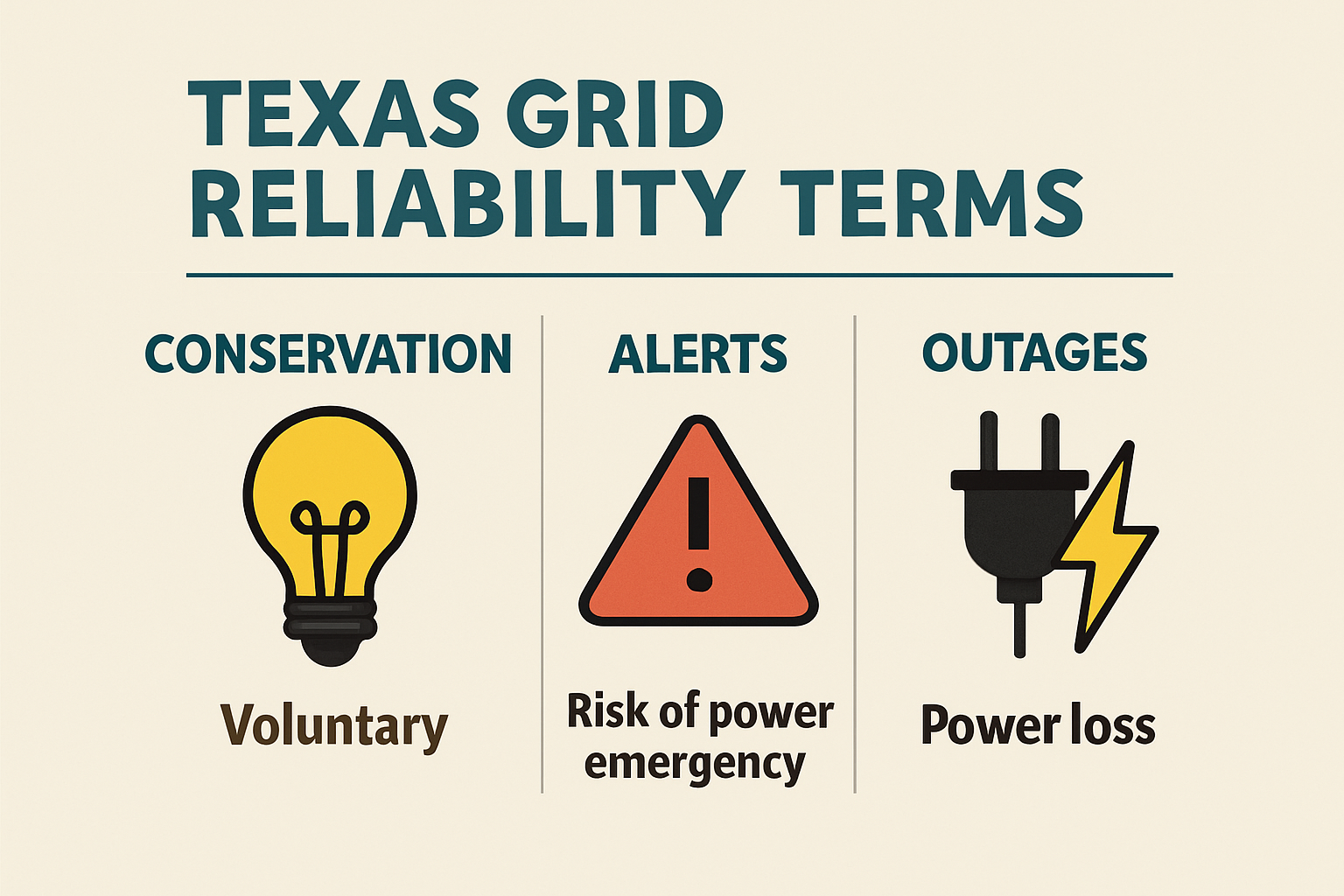
Texas Grid Reliability Terms: Conservation, Alerts, and Outages
Why the vocabulary matters
If you live or run a business in most of Texas, your electricity news feed is full of shorthand: conservation appeals, emergency alerts, reserve margins, and sometimes the dread phrase “rotating outages.” The words sound interchangeable, but they sit on different rungs of the same ladder—from ordinary market operations to rare, system-wide interventions. Sorting them out helps you understand what is being asked of you, how urgent it is, and what still sits between a stressed grid and your breaker panel.
The wider grid context Texas sits inside
Physically, the continental United States is organized into three large alternating-current interconnections that, in normal conditions, move power among many states and provinces. According to the U.S. Energy Information Administration, those interconnections “mostly operate independently from each other and rarely transfer electricity among them,” while the Eastern and Western Interconnections are also linked into Canada’s network, creating multiple paths for power to flow and reducing the odds of a single failure cascading everywhere (¹).
Within each interconnection, day-to-day matching of generation to load is handled by balancing authorities—entities that “ensure electricity supply constantly matches power demand.” The same EIA overview explains that most balancing authorities are utilities that have taken on the role for their footprint, while U.S. regional transmission organizations also serve as balancing authorities, with one notable exception: “ERCOT is unique because the balancing authority, interconnection, and regional transmission organization are all the same entity and physical system” (¹). That structural fact matters later when you read about limited import options during a crisis.
The physical stack still matters for intuition. Power plants send energy outward on high-voltage transmission lines because, as the EIA summarizes, higher voltages make long-distance movement more efficient and less costly; transformers at substations step voltages up or down as electricity travels toward lower-voltage distribution circuits that are safer inside homes and businesses (¹). When headlines talk about “the grid,” they are usually blending those bulk pathways with the local wires your utility maintains.
Across much of North America outside the ERCOT footprint, mandatory planning and operating expectations for the bulk power system are organized through reliability standards developed by the North American Electric Reliability Corporation and approved by the Federal Energy Regulatory Commission in the United States (¹). NERC’s public standards index groups those expectations into families—one of which is explicitly labeled “BAL - Resource and Demand Balancing,” signaling how central the load-versus-generation ledger is to formal reliability work (²).
Conservation: the softest ask with real engineering behind it
When grid conditions tighten but operators still have tools left, the first public message is often voluntary conservation: turn thermostats up a few degrees, defer large appliances, and shift industrial processes if you can. That is not a personal scolding; it is a system-wide request to shave simultaneous demand so that expensive and scarce reserves are not exhausted in a single hour. The EIA’s narrative about utilities interconnecting after World War II notes that those ties “reduced the amount of extra generating capacity each utility had to have available to ensure reliable service during” periods of peak demand linked to its glossary entry on the term (¹).
Reporting from the Associated Press captured how that playbook looked during an extended Texas heat episode: the Electric Reliability Council of Texas “asked residents to conserve power from 5 p.m. to 9 p.m.” as reserves were expected to be tight again, framing the appeal as a way to get through peak air-conditioning load without crossing into more drastic procedures (³). A separate AP dispatch on the same broader summer noted that repeated conservation calls arrived as the grid was setting fresh electricity-demand records, illustrating how customer behavior is treated as one more dispatchable resource when thermometers stay stubbornly high (⁴).
Conservation language can feel routine precisely because it is designed to be used often. Treat it as an early-warning flare: conditions are manageable, but the margin for error is thinner than operators prefer. The EIA’s discussion of smarter grids notes that devices and pricing signals can inform customers when power is pricier or when incentives exist to cut use—another form of the same demand-shaping logic utilities have applied manually for decades (¹).
Alerts and emergency operations: when the tone shifts
When voluntary cuts are not enough, operators can move into declared emergency operations. In the heat-episode coverage cited above, AP explained that low energy reserves had prompted ERCOT to issue a “level 2 energy emergency alert,” a status that reflected how tight operating reserves had become relative to soaring demand and, in that reporting, insufficient contribution from wind and solar during the critical period (³). The article noted it was the first time the council had entered emergency operations since the 2021 winter storm that produced prolonged outages (³).
Emergency layers are not just accounting. The same story reported that ERCOT cited a “drop in frequency,” a term that points to the alternating-current heartbeat of the grid slipping out of its tight band when large blocks of generation trip or load swings abruptly—something a Texas A&M engineering professor quoted by AP associated with a large power plant going offline (³). When frequency and reserves are both under pressure, operators are closer to the last-resort toolbox.
AP’s reporting also underscored how politically charged reliability has become: state leaders argued post-2021 reforms had stabilized conditions, while the same heat coverage recorded debate over market design, new on-demand generation incentives, and even vetoed efficiency legislation—context that helps explain why public communications can sound as much like governance as engineering (³).
Outages: localized damage versus systemic curtailment
Not every outage is a “grid failure.” The EIA’s delivery overview reminds readers that utilities operate the distribution system that connects premises to the wider network, while high-voltage transmission moves bulk energy over long distances (¹). Ice storms, high winds, and vehicle strikes still interrupt lower-voltage segments the way they always have, even when bulk supply is ample.
Systemic events look different. During Winter Storm Uri in 2021, AP summarized state health data attributing 246 storm-related deaths to the multi-day crisis and described freezing conditions that “crippled the state’s power grid for five days,” a reminder that the failure mode was not only fallen branches but widespread loss of usable generation and fuel-system performance during extreme cold (⁵). The same wire package quoted analysts drawing a lesson from Uri about enforcing cold-weather readiness for power plants and fuel infrastructure rather than blaming line damage alone (⁵). Heat-era coverage, meanwhile, described the system being “pushed to the brink of outages” before conservation and improving wind conditions helped ERCOT through another tight peak (³).
Understanding that distinction helps households interpret social-media photos of bucket trucks against official ERCOT charts: one is often a neighborhood repair timeline; the other is a statewide balancing fight.
Imports, islands, and why neighbors cannot always ride to the rescue
Heat-coverage reporting also highlighted a structural constraint that shapes every Texas reliability conversation: the state “is not connected to the rest of the country’s power grid,” leaving “few options to pull power from elsewhere amid shortages or failures” (³). Read alongside the EIA’s explanation that interconnections “rarely transfer electricity among them,” the point is not parochial pride—it is a reminder that conservation, local generation, demand response, and carefully staged emergencies are the main shock absorbers available on short notice (¹).
Historically, the EIA recounts, thousands of isolated utilities knitted themselves together after World War II to share plants and reduce how much spare capacity each neighbor had to carry individually—an origin story that makes today’s scarcity episodes feel even sharper when a region cannot lean on a synchronous neighbor (¹).
Putting the pieces together for customers
At bottom, the vocabulary tracks how close planners are to violating the iron law the EIA states plainly: electricity supply and demand must stay “precisely balanced” to avoid blackouts, and balancing authorities manage transfers with neighbors when interties exist (¹). Voluntary conservation is the light-touch lever; formal emergency declarations say the professional control room is already deeper into its playbook; sustained outages—whether from Uri-scale winter collapse or summer reserve exhaustion—are the outcomes everyone is trying to avoid.
If you remember only three phrases, make them these: conservation is cooperation before the math gets ugly; emergency alerts mean reserves and frequency are already flashing yellow or red; outages can be your street’s transformer or the entire balancing area’s last resort. Knowing which is which keeps you calmer—and helps you time thermostat tweaks, backup tests, and business continuity drills for the right class of risk.