
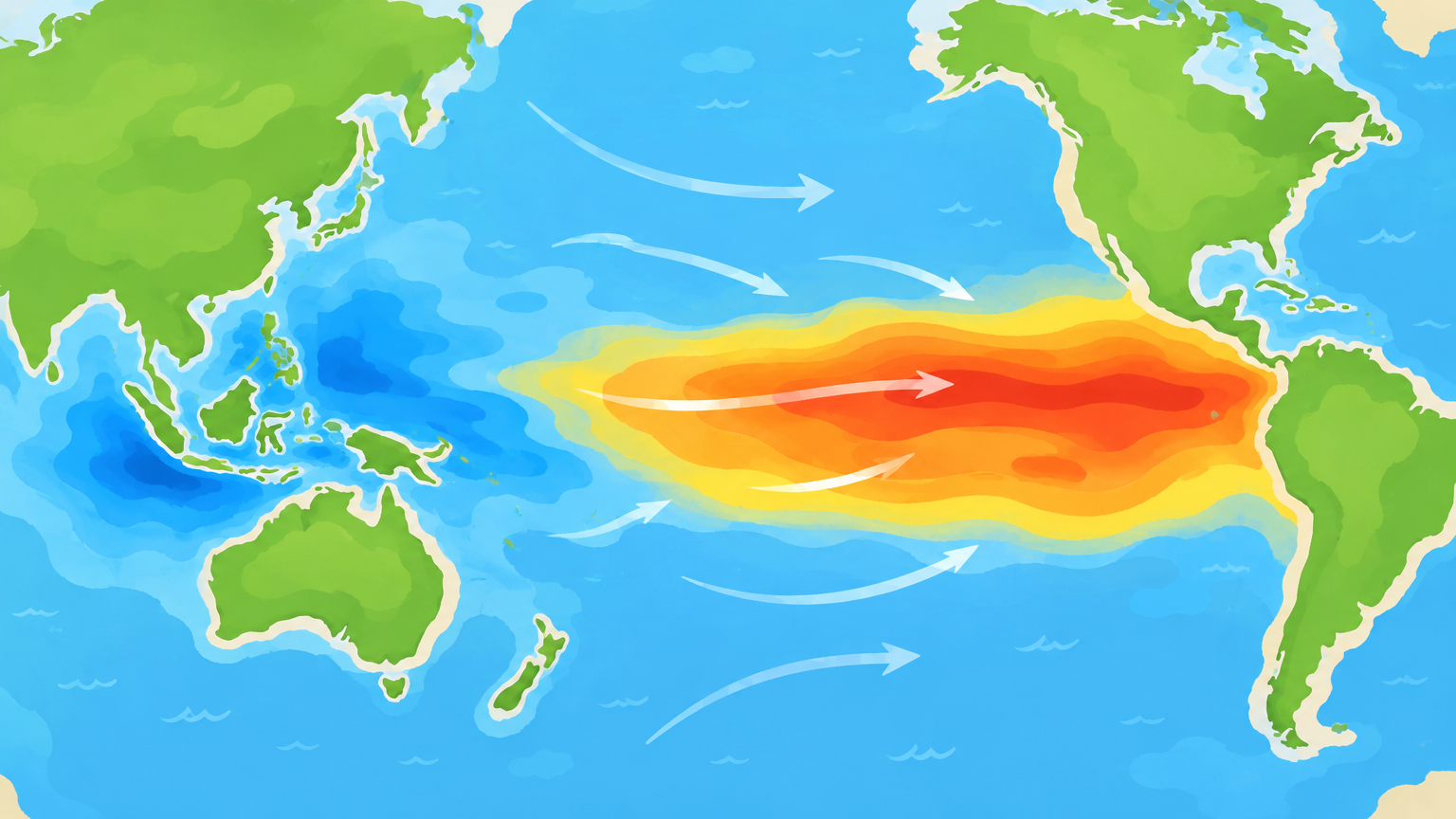
Most of us don't think about the Pacific Ocean when we open an electric bill. This winter, though, forecasters expect a warm patch of that ocean to get stronger and stay strong into early 2027. The Climate Prediction Center (CPC), part of the National Oceanic and Atmospheric Administration, is the agency making that call. The pattern is called El Niño, and its main path to your bill runs through the weather. It changes how much heating and cooling homes need, and how much water and wind power the grid can count on. Nobody can say from the forecasts alone whether your rate will go up or down because of it.
What El Niño is
Scientists watch the surface of the tropical Pacific. When a central band of that water runs warmer than normal, they call the pattern El Niño. When it runs cooler, it's La Niña. Both belong to a larger cycle called ENSO, short for El Niño–Southern Oscillation.
An episode usually lasts 9 to 12 months. CPC's ENSO cycle guide says they often form between June and August, usually peak from December through April, and come around every three to five years on average. NOAA's Ocean Service gives a wider range of two to seven years and says there's no fixed schedule. In winter, that same NOAA page says, El Niño usually brings wetter weather to the southern U.S., including the Gulf Coast and Southeast, and warmer, drier weather to the north. So one El Niño can hit two households in very different ways.
What forecasters expect through early 2027
In its November 2026 discussion, CPC said El Niño is still strengthening. The Niño-3.4 index tracks a stretch of the central tropical Pacific, and it reached +2.5°C there, about 2.5 degrees warmer than normal.
CPC puts better-than-79 percent odds on a strong to very strong El Niño from January through March 2027. It also gives about a 60 percent chance of a "historic" event for the October to December and November to January periods. CPC uses that word when a three-month value on its relative index, called RONI, reaches +2.5°C or higher, compared with every El Niño back to 1950. The agency expects the event to start weakening in early 2027.
Those numbers are odds. CPC says El Niño-type impacts are more likely, though not guaranteed, even with a very strong event. Its strongest U.S. weather effects usually arrive from December through April, so that's the stretch to watch.
How the weather reaches your bill
Generating power is the biggest slice of what electricity costs. EIA's guide to electricity prices says extreme heat and cold raise demand for heating and cooling, and that higher demand can lift fuel and electricity prices. Weather also changes how many kilowatt-hours (kWh) your home uses. A kWh is the unit your bill counts. It's what a 1,000-watt appliance uses in one hour.
Supply is the other path. Rain and snow feed hydropower, and wind can supply low-cost electricity when the wind blows steadily. EIA says that when drought or calm weather cuts that output, the lost generation can push up prices for other fuels and power. Natural gas plants supply a big share of the power. EIA's Short-Term Energy Outlook expects them to supply close to 40 percent of U.S. electricity in 2026 and 2027, so their fuel costs still feed into what power costs.
EIA's November outlook expects total U.S. electricity generation to grow 1.2 percent in 2027, slower than the 2.7 percent growth it expects for 2026. The forecast assumes milder summer weather next year, which lowers home demand, while business demand keeps rising. EIA also expects about 72 gigawatts of new solar and 20 gigawatts of new wind capacity to come online across 2026 and 2027. Wind output still depends on wind speeds, so a calm stretch can cut it even with more turbines built.
The same outlook has no 2027 retail price forecast, and it doesn't mention El Niño. So nobody can say whether El Niño will push your rate up or down next year. Your plan's rate and terms decide how much of any market move reaches you, which makes them the first place to look.
What to check on your bill
Usage can matter as much as price. A hot week keeps the air conditioner running longer, which pushes up your kWh even if your price per kWh stays the same. EIA says most consumers pay prices based on the seasonal average cost of electricity, so they don't feel the day-to-day swings. Prices are usually highest in summer, but a short spike may not show up as a jump on your bill.
Here's one way to see the math. Picture a hypothetical family, the Ortiz family. In a normal month they use 900 kWh. At 17.30 cents per kWh, the 2025 U.S. average residential price EIA reports, their energy charge comes to about $155.70 (900 × $0.1730). That's a national average used for illustration, not a quote for any home.
Now look at two changes. A one-cent rise is about 6 percent of that price, and on 900 kWh it adds $9 a month. In a hot week, the Ortiz family might use 1,000 kWh. At the same price, that month costs $173.00. The extra 100 kWh adds $17.30, nearly double what the one-cent rise added. In this example, the usage jump moved the bill more than the price did.
When a bill jumps, go through four things in this order:
- Usage. Compare kWh with the same month last year. A usage jump can explain a higher bill before any price change does.
- Price per kWh. Find the energy price line and see whether it changed.
- Weather. Note any heat, cold, dry or very calm stretch in that billing period.
- Rate type. A fixed rate stays the same for its term. A variable rate can change, so know which one you have.
Rate type changes the picture. On a fixed rate, weather mostly reaches you through how much you use. On a variable rate, prices can follow the market sooner, so the price line is worth checking every month. A fixed rate only protects you for its term, so read the renewal terms before the end date.
What to watch next
CPC's next monthly ENSO discussion is due December 10, 2026. The agency also issues official 30- and 90-day outlooks once a month, near mid-month, with maps. Those show seasonal odds, not the weather on any one day. For a specific week, your local National Weather Service forecast is the better guide.
The forecasts can't isolate El Niño's effect on your bill, so nobody can say how much of any change it causes. Same drill each time a bill jumps: usage first, then the price, then the weather behind both.