
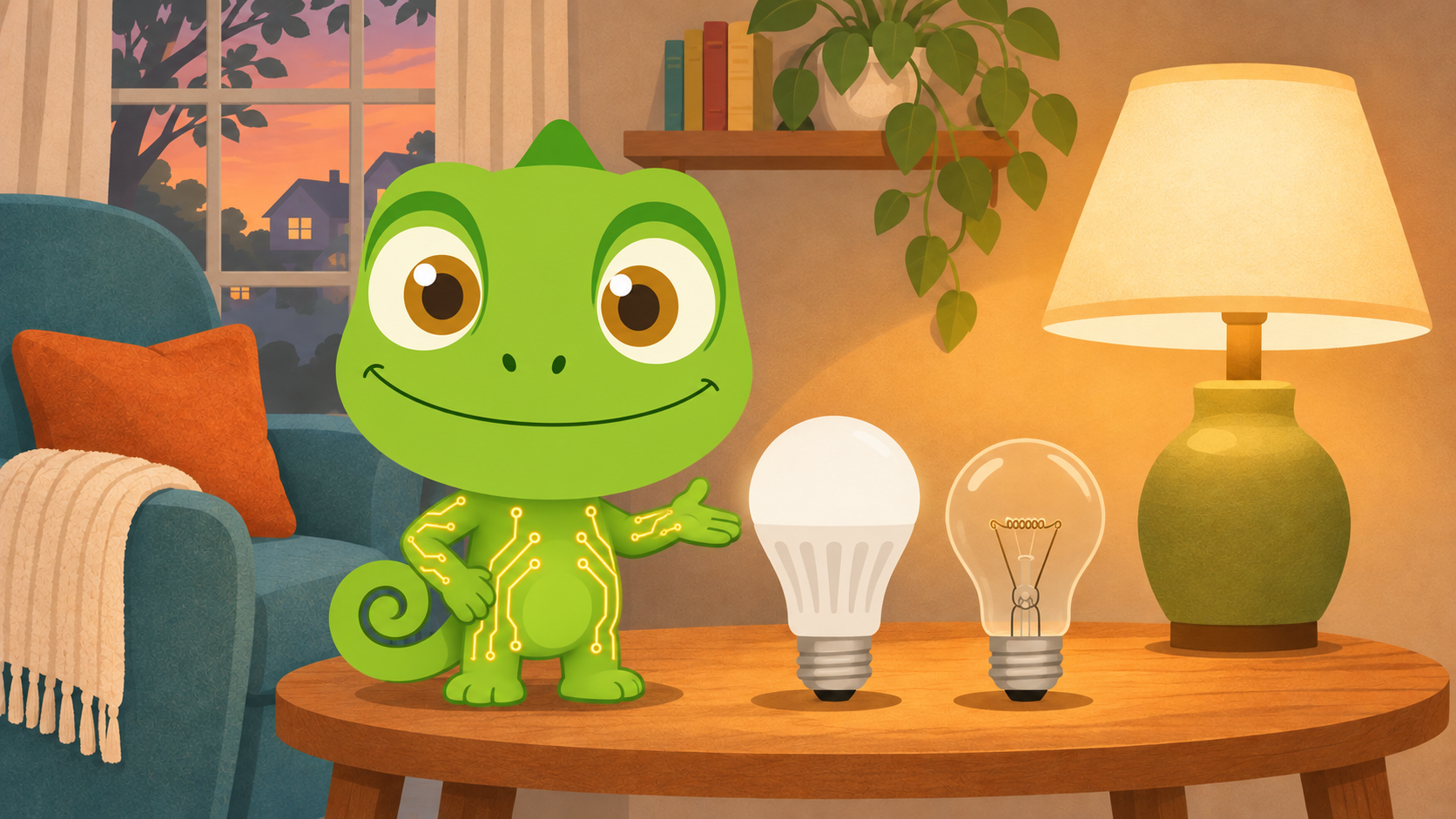
When an incandescent bulb burns out in a lamp you use every night, it’s a good time to try an LED. You can keep about the same brightness and spend less to run the lamp. If the old bulb was 60 watts, look for 800 lumens on the LED box. The Department of Energy’s light bulb buying guide lists LED bulbs at 800 lumens drawing about 5.9 to 10.5 watts, while the 60-watt incandescent bulb it replaces makes about 800 lumens.
Lumens tell you how much light comes out of a bulb. Watts tell you how much power it takes to make that light. Check lumens first, because a lower watt number only saves power when the light matches. The Department of Energy says LED lighting now offers the highest efficiency of any light-source technology, and that efficiency is why an LED can match 800 lumens on a fraction of the power. DOE’s LED Basics
Start with the light you already like
If the old bulb shows its lumens, match that number. If all you can find is its watts and you know it’s an old incandescent bulb, use the table below. It shows the rough matches from the same DOE guide. The room examples are starting points for one bulb, not guarantees.
| If the old bulb was | Start around | Think of |
|---|---|---|
| 40 watts | 450 lumens | A soft bedside lamp |
| 60 watts | 800 lumens | A living-room lamp you read by |
| 75 watts | 1,100 lumens | A brighter lamp by a desk |
| 100 watts | 1,600 lumens | A bright light over a workbench |
Those are numbers for the bulb itself. A dark shade can make the same bulb seem dimmer, and a lamp that points up will light a room differently from one that shines onto your book. If you liked the light your old bulb gave you in that very lamp, matching its lumens is a good first move.
Keep the room feeling the same
There’s one more number worth checking when you turn the box around. Look for 2,700 K if you want the warm glow most old bulbs gave off. The K stands for kelvins, the unit that describes the color of the light. DOE’s color table puts 4,100 K in its cool range, a light it lists for offices, classrooms and showrooms. DOE also says a big jump in color, such as going from 2,700 K to 4,100 K, is noticeable, so it’s worth matching the number you already have.
Take a moment to check the fixture, too. DOE notes that LED bulbs are often bigger than old ones, especially near the base, so some won’t fit into smaller fixtures. Bring the old bulb or measure it if the space is tight. If the fixture fully encloses the bulb, such as some covered glass lamps, look for an enclosed-fixture rating on the box. DOE says trapped heat can affect the performance and life of certain LEDs. If the lamp has a dimmer, check that the bulb is rated to dim and works with your dimmer.
How much could that one bulb save?
This is a hypothetical example, not a measured result. Suppose the living-room lamp runs three hours a day, every day of the year. Replacing its 60-watt bulb with a 10-watt LED cuts the power it uses by 50 watts. Over a year, that saves about 55 kilowatt-hours (kWh), the unit your electric bill uses to measure energy. At an example rate of 10 cents per kWh, the lamp would cost about $5.50 less per year to run. At an example rate of 20 cents, it would save about $11. Your own hours and rate change the math.
That’s why it makes sense to start with the lights you use most. The living-room lamp might be on every evening. A closet light you switch on for a minute at a time will save far less. If you’re buying one bulb today, take a picture of the old bulb’s markings before you go. It’s an easy way to bring home the light you meant to buy.
Explore your energy options
Compare plansHow much could you save by switching to LED bulbs?
Say you replace an old 60-watt bulb with a 10-watt LED. Both give off about 800 lumens, or about the same amount of light. Here is what you could save if each light runs 3 hours a day.
| Location | Price per kWh | One bulb saves | Five bulbs save |
|---|---|---|---|
| U.S. average | 18.16¢ | $9.94 | $49.71 |
| Texas | 15.91¢ | $8.71 | $43.55 |
| Ohio | 19.38¢ | $10.61 | $53.05 |
Start with the bulbs you leave on the longest. The more hours you use a light, the more electricity you can save. These estimates use averages from the U.S. Energy Information Administration. Your price and hours may be different. The table shows electricity savings before the cost of buying the bulbs.